Showing posts with label REVIEW. Show all posts

Saturday, 3 March 2018

"The Triplets of Belleville" REVIEW


   "The Triplets of Belleville" is French surrealistic animation film also made as a "film noir" where brilliant music acts as the main language, it is almost mute after all.
   "The Triplets of Belleville" tells us a story of the adventures of Madame Souza, her grandson Champion and a dog named Bruno. Champion was fond of bicycles and seeing how he wanted to cycle, his grandmother presents him with a bicycle. At the same time she start to raise Champion as a real champion. After that we can already see Champion as an adult and Madame Souza as his personal trainer, preparing him for the "Tour de France".
Figure 1. A bicycle for future champion (2012)

   However, at this race, everything goes awry: Champion falls into the hands of Mafia, who take him overseas for bicycle slavery. And, naturally, his grandmother and his dog go after them to rescue their champion.
   One can say that the plot here in not very important, because the main thing in this animated film are all the details, which develops a special mood. "Despite its simple story The Triplets of Belleville is an unending source of visual wonders and delights".(Devin D. O'Leary, 2004) Every frame is very soulful and filled with spirit. You feel the need to put this film on pause, take a magnifying glass and look at all the smallest details in it.
As said before all characters of "The Triplets of Belleville" practically do not say anything. It is silent movie to music, speech here is foreign, unnecessary. All these characters are living caricatures. There are old tall women who every night arranges unusual concert in the restaurant where one is playing on the fridge, the other on the vacuum cleaner, and the third rhythmically crumples newspaper near the microphone. There are stereotypically fat Americans. Double jointed waiter with eyes of an eagle.(see fig.2) Square Mafiosi that merge together to form a rectangle. Literally, every single character of this film is painted very carefully, detailed and with love.

Figure 2. Americans and waiter (2017)

   "The Triplets of Belleville" is an animated satire with grassroots (mundane) humour. In the overseas capital you can easily recognize New York, and in the obese sculpture - the Statue of Liberty.(see fig.3) The director of this film tape Sylvain Chomet constructs incredible designs from ordinary objects: a bicycle-gramophone, a lawn-mower-massager, a dog-tire, etc. Sylvain Chomet(2003) himself says that "I am really interested in is drawing caricature, how far you can push it, seeing if you can achieve something really strong, almost abstract[...]"
Figure 3. The Statue of Liberty (2012)


   However because this movie is very rich of everything:  with all different storylines, an abundance of characters, changing genres, it becomes very difficult and tiresome to perceive it. "The Triplets of Belleville" holds only on beautiful visuals and brilliant music. This can bore some viewers.
   "The Triplets of Belleville" is a soulful nostalgia for the past times, "Its style evokes a postwar France"(Anthony Oliver Scott, 2003)  and a must-see movie for any fan of animation.

Bibliography:
1. O'Leary, D. D. (2004) THE TRIPLETS OF BELLEVILLE This wordless wonder is a weird, witty winner. At: https://alibi.com/film/7144/The-Triplets-of-Belleville.html (Accessed on 1 March 2018) 
2. Chomet, S. (2003) [Interview face to face, 20th November 2003]
3. Scott, A. O. (2003) FILM REVIEW; Nostalgia For a Land That Twirls In Dreams.  At: http://www.nytimes.com/movie/review?res=9E04E1DA1F3BF935A15752C1A9659C8B63 (Accessed on 1 March 2018) 

Illustrations:
1. Figure 1. Munoz, M. (2012)[Film Still] http://www.abc.es/20120710/deportes/abci-deportes-celuloide-201207061253.html, accessed on 1 March 2018.
3. Figure 2. Beaver, N. (2017)[Film Still] https://blunderbuss.club/2017/05/18/triplets-of-belleville/, accessed on 1 March 2018.
2. Figure 3. (2012)[Film Still] http://robydickfilms.blogspot.co.uk/2012/08/les-triplettes-de-belleville.html, accessed on 1 March 2018.

Thursday, 1 March 2018

"Waltz with Bashir" REVIEW


   There are a lot of films about war in history of world cinema, however this is not the case with animated movies. "When the wind blows", "Persepolis", "Tale of Tales" etc. only confirm that it is not easy to convey the cruelty and reality of war in animated films.
In 2008 Israeli documentary artist Ari Folman presented a film in which he combined 2D and 3D animation, documentary and live-action genres and the main topic of it was the first Lebanon War in which Folman himself took part.
   The first documentary part of "Waltz with Bashir"  is a journalistic investigation, during which Ari Folman himself, talks with his brother-soldiers and eyewitnesses of events that happened during Lebanon War, tries to collect lost pieces of his memory, since he can hardly recall what actually happened. Here the director talks a lot about this effect of human memory, which is able to selectively remember, selectively forget or even construct non-existent memories from remainings of various incidents. Folman investigates this phenomenon by speaking with different experts who explain this as a special aspect of a human brain in a situation of extreme stress, like war, for example for a young and inexperienced guy. Director compares this effect on just a single mind to the same effect but already on a whole mankind. That sometimes mankind’s historical memory fails so much, that it starts to rewrite some events or even worse, it starts to invent events that never actually happened. Hussein Ibish (2009) says that  "Waltz with Bashir"   focuses "especially on the distortions caused by constructed and retrospective memories based on events that took place long ago–even those that never happened at all and are only imagined[...]"
Figure 1. Ari Folman trying to recollect his memories (2015)

   Israel still cannot come to a conclusion of what actually happened during the events in Lebanon, especially the massacres in the Sabra and Shatila, the camps of Palestinian refugees (which is the one of main topics of the film). The director tries to get answers about the degree of involvement of Israeli army and government in this genocide. Naira Antoun(2009) says that "it is a film charting an Israeli quest to remember — or to unforget — the Israeli role in the brutal massacre of Palestinians in Sabra and Shatila. Or at least, this is the film’s ostensible purpose.Ostensible purpose or not this story is about the specific events, that rise obvious and every human problem of any war.  This animated film shows the state of mind of every soldier who just appeared on a real battlefield that is what was important. Some scenes perfectly show the whole absurdity of the situation. For example, the scene in the tank when the commander is killed, and the other soldier who must replace him, is just sitting dumbfounded, not yet fully realizing what is happening. Or another moment, where people in shelters die from explosions, but a single soldier dancing a waltz under intense gunfire remains alive.(see fig.2) This film emphasize these moments very well.
Figure 2. Soldier dancing and shooting under intense gunfire (2016)

   "In his film “Waltz With Bashir” Ari Folman placed the Palestinian refugees alongside the victims of the Holocaust. " (Bashir Bashir, 2015) Indeed, it can be acceptable, after all the director seems to be horrified by the fact that the nation that survived the Holocaust, after 40 years turned out to be in a same situation but on the opposite side. Where children and grandchildren of Auschwitz victims, were illuminating the night when Christian Phalangists were killing Muslim old men and children. This indicates that there is still room for healthy self-criticism in this country and in the world.
Figure 3. Dead child of a massacre (2016)

Bibliography:
2. Ibish, H. (2009) A Waltz With the Dogs of Memory. At: https://www.thenation.com/article/waltz-dogs-memory/ (Accessed on 28 February 2018) 
1. Antoun, N. (2009) Film review: “Waltz with Bashir”. At: https://electronicintifada.net/content/film-review-waltz-bashir/3547 (Accessed on 28 February 2018) 
3. Bashir, B. (2015) The Holocaust and the Nakba. Memory, National Identity and Jewish-Arab Partnership. At: https://www.hsozkult.de/publicationreview/id/rezbuecher-25731 (Accessed on 28 February 2018) 

Illustrations:
1. Figure 1. (2015)[Film Still] https://activismolucha.wordpress.com/2015/01/09/conocer-nuestro-pasado-para-seguir-avanzando/, accessed on 28 February 2018.
3. Figure 2. (2016)[Film Still] http://mstamp176.blogspot.co.uk/2016/03/film-review-waltz-with-bashir.html, accessed on 28 February 2018.
2. Figure 3. (2016)[Film Still] http://basementrejects.com/review/waltz-with-bashir-2008/, accessed on 28 February 2018.

Friday, 9 February 2018

"Paprika" REVIEW


   With his latest film, in every sense of the word, made as Japanese animation – anime, called "Paprika", Satoshi Kon managed to impress viewers and experts with his talent as a narrator, with his bright visual style and ability to magnificently intertwine reality and illusions. "Paprika" is a psychedelic detective about entering dreams.
Figure 1. Dream World warps (2013)

   The script of "Paprika" is an adaptation of the science fiction novel of the same name by Yasutaki Tsutsui, the author of other quite famous works. Tsutsui’s novel is very action-packed, author showed well the psychological portraits of the characters, and his attention to the details is amazing.
   The main heroine, Atsuko Chiba, heads the research of the human psyche. She also has an alter-ego - a teenage girl Paprika, who sometimes has enter other people's dreams, not always legally, in order to secretly mentally heal important statesmen, secretly from the public. However, a catastrophe happens as the secret experimental device, DC-mini, disappears, which allows entering other people dreams without their consent. This incident is the beginning of a chain of strange events, in which almost everything and everyone around Chiba is involved.
   Considering the impressive volume of the novel and the number of plot lines in it, Satoshi Kon decided to recapture the atmosphere and spirit of the novel, not the volume. And although, inevitable changes and simplifications were introduced into this complex work, the structure of the anime turned out to be no less complicated, because of director’s talent, which enriched the universe of "Paprika" a lot. Martin Petto(2009) is correct when he states that "Kon's visual panache is a welcome replacement for Tsutsui's ponderous psychoanalysis. " He says that "In all respects the film is brighter, brasher, breezier[...]lunch. Everything in the book is slower, more clinical."
   If Tsutsui’s novel is a psychological thriller, then the anime version more resembles an endless surreal maze of unexpected visual images, symbols, moral dilemmas, various references, plot twists, films in the film, stories in the story and dreams in a dream. Roman J. Martel(2013) points out one of most popular scenes of "Paprika" : "The dream parade is one of those sequences that will probably stick in your mind whenever you think of the film, because it is so strange, colorful and unique that you can’t help but be impressed with it."
Figure 2. Parade (2010)

   Satoshi Kon is clearly interested in a part of human life, especially dreams, which, according to many experts, are the key to a better understanding of the problems and needs of man, as well as to treat most of the psychiatric problems. Caleb Crain(2011) wonders" Will people use the technology to reach a new understanding of themselves, extending the insights of psychoanalysis and philosophy? Such a development would require a great deal of attention to people as individuals. " However he claims, and one must fully agree,  that " It would probably be easier and more profitable to use the new technology for entertainment. "
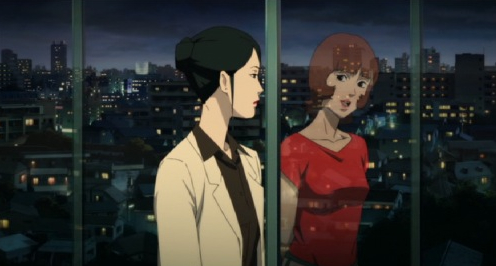
   "Paprika" is very optimistic film, because of Paprika herself, who feels in dreams, like at home. She is a cheerful and playful girl who does not lose her self-control. It is very interesting to see that invisible connection between Paprika and Chiba . Subconsciously you can feel it, but verbally it is difficult to describe it.
Figure 3. Chiba and "her" Paprika (2013)

   Despite the beautiful visuals and quite interesting plot, you want to taste these Japanese spices only once. However, they will leave a good and hot aftertaste.

Bibliography:
2. Petto, M. (2009) TWO TASTES OF PAPRIKA: YASUTAKA TSUTSUI'S NOVEL (TRANS. ANDREW DRIVER), AND SATOSHI KON'S ANIME At: http://strangehorizons.com/non-fiction/reviews/two-tastes-of-paprika-yasutaka-tsutsuis-novel-trans-andrew-driver-and-satoshi-kons-anime/ (Accessed on 6 February 2018) 
1. Martel, J. R. (2013) Paprika - 2006. At: http://romansreviews.blogspot.co.uk/2013/09/paprika-2006.html (Accessed on 6 February 2018) 
3. Crain, C. (2011) An introduction to “Paprika”. At: http://www.steamthing.com/2011/03/an-introduction-to-paprika.html (Accessed on 6 February 2018) 

Illustrations:
1. Figure 1. Martel, J. R. (2013)[Film Still] http://romansreviews.blogspot.co.uk/2013/09/paprika-2006.html, accessed on 6 February 2018.
2. Figure 2. Lamar, C.(2010)[Film Still] https://io9.gizmodo.com/5624767/the-final-blog-post-of-satoshi-kon, accessed on 6 February 2018.
3. Figure 3. Martel, J. R.(2013)[Film Still] http://romansreviews.blogspot.co.uk/2013/09/paprika-2006.html, accessed on 6 February 2018.

Friday, 2 February 2018

"Mary and Max" REVIEW


An incredible story of Mary and Max was made by Australian director Adam Elliot in 2009.
Two lonely souls, the meeting of which is impossible in real life, find each other and become penpals. Mary Daisy Dinkle is an eight-year-old girl from Australia with the eyes of  "the colour of muddy puddles" and a birthmark of "the colour of poo". And  Max Jerry Horowitz who is a lonely 44-year-old Jewish atheist from New York , "smells like licorice and old books" and whose circle of friends consists of  TV set, personal psychoanalyst and a sick aquarium fish.
A gray world, in which Max and Mary live, is full of annoying sounds, unpleasant scents, and even the Statue of Liberty looks pretty beaten up by life. But this no longer saddens neither the girl nor the man: their lifelong dream of finding a friend has finally come true. Now they have one thing to do: Mary - learning how to love yourself, Max - overcoming the nervous attacks that appear every time he reads a new Mary’s letter.(see fig.1)
Figure 1. Max's nervous attack (2014)

The reason for the penpalling was Mary’s puzzling question: "Where babies come from in America". Mary says that in Australia children are found in beer mugs, then in America they should come from cola cans. Mr. Horowitz, whose was randomly selected from the phone book of New York, senses his soul mate on the opposite side of the planet and answers Mary’s question. In addition to a naive and honest view of the world of these two different people, it turned out that they have a passion for chocolate bars, some cartoon about creatures living in a teapot and utter social dysfunction.
"Mary and Max" mostly consists of various quotes from conversation of these two characters, which are well-read by voice-overs, skillfully and funny acted out by dolls(puppets) and arranged in chronological order:  first letters date back to the mid-70's, the last - the beginning of the 90's.
. Narrated by clever shots, this gray story of "Mary and Max" is very far from the Hollywood tearjerker. As Adam Elliot said himself :"It's not the sort of story you'd see from (Hollywood studios) DreamWorks or Pixar.F It deals with different or marginalized characters"(Bob Tourtellotte, 2009) This picture has black humor and, along with kindness, it sends a strong message to all of us that" "Friends are the family we choose for ourselves"."Mary and Max" is a tragicomedy. On the one hand, you cannot remain indifferent to different topics and events that unfold there. But on the other hand, all tragic moments are flavored with humor and a little touch of self-irony. One genre very neatly and quickly intertwines with another. Luke Buckmaster(2009) is correct when he states that "One moment we're watching the blogs of plasticine make poo jokes, and the next we're confronted by heartrending explorations of heavy things - mental illness, alcoholism, loneliness, sociology."
Figure 2. Mary and Max "meeting" (2015)

Despite all the gloom and emotional stress, this film leaves a ray of light in all of us. After all, despite all the obstacles, tragedies, diseases and phobias, this friendship lasted until the very end. Tears in a bottle(see fig.3), clumsy drawings, chocolates, cans of condensed milk, alternative versions of where the children come from and confessions of two people that will never meet - all these little things of which our life consists, are enough to cause a smile, not only on your face, but also in your heart. As Andrew Todd(2015) said: "Mary and Max is a classic of animated cinema, effortlessly eliciting the holy grail of audience reactions: laughter through tears."
Figure 3. Mary's tears for Max who does not cry (2014)


Bibliography:
1. Tourtellotte, B. (2009) Sundance opens with hope for indie film. At: https://www.reuters.com/article/us-sundance-opening/sundance-opens-with-hope-for-indie-film-idUSTRE50F05Z20090116 (Accessed on 31 January 2018) 
2. Buckmaster, L. (2009) Mary and Max film review: plasticine-powered profundities. At: https://blogs.crikey.com.au/cinetology/2009/04/09/plasticine-powered-profundities-film-review-mary-and-max/ (Accessed on 31 January 2018) 
3. Todd, A. (2015) Love Yourself First: Mental Illness In MARY AND MAX. At: http://birthmoviesdeath.com/2015/06/19/love-yourself-first-mental-illness-in-mary-and-max (Accessed on 31 January 2018) 

Illustrations:
1. Figure 1. Newbutt, N. (2014)[Film Still] https://blog.animationstudies.org/?p=704, accessed on 1 February 2018.
2. Figure 2. Alves, M.(2015)[Film Still] https://milcaretas.com/2015/03/20/mary-e-max-uma-amizade-diferente/, accessed on 1 February 2018.
3. Figure 3. Lavine, M.M.(2014)[Film Still] https://reeltalk.areavoices.com/2014/05/22/indiewatch-mary-and-max-a-heavy-hitting-claymation-delight/, accessed on 1 February 2018.

Monday, 11 December 2017

"The Intouchables" Comedy


   Film "The Intouchables" is a French cocktail of comedy and drama made by Olivier Nakache & Eric Toledano.
   Philippe is a wealthy connoisseur of art, an aesthete, who became a paralytic due to an accident. Everything is hand on a plate to him. Driss is a young dark-skinned man from slums of Paris with "criminal tendencies". They have nothing in common. However, these two were destined to meet and, strangely enough, form a friendship. Both of them are untouchable and, therefore, lonely. Society would not accept them, they look like outsiders. Watching "The Intouchables" you forget that this story is about two outcasts, as the creators of the film  immediately set the correct tone to the narrative: very realistic, comical, kind and not vulgar. Roger Ebert (2012) points out that "The appeal of a film like this, and it is perfectly legitimate, is that when we begin to feel affection for the characters, what makes them happy makes us happy. "
Figure 1. Driss and Philippe (2012)

   It is surprising how subtly and tactfully filmmakers use humour in the story of Philippe. Directors manage to simultaneously not offend people from whom these characters are based, because this film is based on real story, but also show life as it is, without embellishment and falseness. Almost every scene is universal, thus creating a benevolent atmosphere. Creators tried to "squeeze"  the maximum of opportunities out of real story.

   Undoubtedly, the fact that "The Intouchables" does not have any clichés and moral barriers when showing the life of disabled people really pleases. Thanks to the positive energy and humour without any barriers, this film is able to completely erase all borders that prevent people from understanding each other.

Bibliography:
1. Ebert, R. (2012) THE INTOUCHABLES. At: https://www.rogerebert.com/reviews/the-intouchables-2012 (Accessed on 10 December 2017) 

Illustrations:
1. Figure 1. Ellingson, A.(2012)[Film Still] https://www.pastemagazine.com/articles/2012/05/the-intouchables.html, accessed on 10 December 2017.

Sunday, 10 December 2017

"The Shining" Adaptation


   "The Shining" is a horror film by a famous director Stanley Kubrick, it is an adaptation of a novel "The Shining" by the same famous author Stephen King.
   However Stephen King dislikes this cult- favourite adaptation of his novel "The Shining". At the same time, he said that he considers Kubrick's work to be "impressive", immediately accompanying the praise with a humiliating comparison: "It’s like a big, beautiful Cadillac with no engine inside it."(Stephen King, 2016) He mentions that the character of Jack        Torrance does not develop in this film.
   It should be noted that writer’s negative attitude towards this adaptation, is not entirely groundless.  In King’s novel main heroes really have much more depth in their characters. Nevertheless, Stanley Kubrick is known for the fact that he actually used writer’s texts to form the plot, creating absolutely independent and magnificent works.
Figure 1. Film's poster and Book's cover (2015)

   This is what Stanley Kubrick(1980) thinks of Stephen King’s novel: "Novel seemed to strike an extraordinary balance between the psychological and the supernatural ."
Kubrick’s made his "Shining" more a psychological drama than a horror; it does not have cliche horror methods inherent to all films of that type. Rather than that, this movie frighten the audience with its oppressive atmosphere, feeling of paranoia and depression and tensions in a relationship of Torrance family.
   Speaking about our main protagonist in The Shining, from the very beginning he seems very suspicious type with his inner demons living inside him. It looks like this film doesn't want us to empathise him from the start. From Svyatoslav Sergeev's research(2016) of The Shining, "Stephen King tried to persuade Kubrick from inviting Jack Nicholson to the leading role of Jack Torrance...He wanted to convince Kubrick that the audience is much more interested in watching the gradual madness of the actor with initially normal facial expression rather than Nicholson, who from the very beginning of the film has a very crazy look." That is true that Jack Nicholson's facial expressions are sensationally astounding, but it's is the main reason what makes his character look so real. Just by looking at Torrance you can understand that this man is mad, he was initially crazy. The Overlook Hotel, the Torrance family stayed in, did not break him down mentally; he was already broken, the hotel just provided this man with the environment where he was able to unfold fully.
Figure 2. Jack Nicholson as Jack Torrance(2014)

   Stephen King's sequel to the "Shining" - "Doctor Sleep" – looks like an attempt to  get back what is his by right. In the end, King wants to finish the story in his own way.

Bibliography:
1. King, S. (2016) [Interview face to face, 2nd February 2016]
2. Kubrick, S. (1980) [Interview face to face, 1980]
3. Святослав Сергеев(2016) Он уже был похож на человека [In Russian] He no longer looked like a man. At: https://www.stihi.ru/2016/05/04/4691 (Accessed on 9 November 2017) Translated by Anastasija Strelcova

Illustrations:
1. Figure 1. Flint, H.(2015)[Illustration] http://metro.co.uk/2015/06/05/there-are-so-many-differences-between-stephen-kings-the-shining-and-stanley-kubricks-film-5232328/, accessed on 9 December 2017.

2. Figure 2.(2014)[Film Still] https://www.lafabriquecrepue.com/2014/10/14/les-annees-80-films-cultes-a-profusion-par-jennifer/, accessed on 9 December 2017.

Saturday, 9 December 2017

"What We Do in the Shadows" - Mockumentary

   At first glance, it might seem that makers of "What We Do in the Shadows" are debutants, because young filmmakers like to start with low-budget horror films. This is not true, because Jemaine Clement and Taika Vaitity, who appeared in this film as directors, writers, producers and lead actors, successfully work in Hollywood for a quite long time. "What We Do in the Shadows"  is a pseudo-documentary - mockumentary film about sad vampires, made by these New Zealand comedians.
Figure 1. Directors, producers,writers and lead actors(2017)

   The originality of the film lies in the skilful combination of several cinematic genres. It is a mockumentary - a parody even not so much on documentary, as on a television reality-show,  numerous TV programmes where film crew observe and film every step of people. It is a good horror, with good amount of blood. And it is a stunning comedy in which vampire clichés and stereotypes, are demonstrated from  very unusual sides.
The latter is an absolute advantage of the picture. We are used to the fact that "draculas" must live in gloomy castles. However our heroes say that they live together in order not to feel lonely. Vampires live in an ordinary house in a suburb, very unremarkable, without any stereotypical cemetery crosses and stone gargoyles. Vampires find it difficult to live in a company, none of them wants to clean or wash dishes, their wardrobe is clearly out of fashion and inviting outsiders is fraught with another bloody feast. It is difficult to go to restaurants and bars either, because in order to enter a room, vampires need an invitation. They wander about the dark streets of Wellington, looking more like sober loonies, than ones that pose a mortal danger for passers-bies.
Figure 2. Housemate meeting(2014)

   In fact, "What We Do in the Shadows"  is a set of sketches, but mixed together with such skill, that you quickly stop noticing: that this simple story, in some degree, about nothing, in reality is a full-scale drama . In agreement with Alex Heeney (2015) point of view "It never drags and it’s pieced together so expertly that you hardly notice you’re watching so many short scenes".

   Perhaps the secret of this killingly funny movie is that filmmakers do not seek to create a  parody of all vampire films: "Nosferatu", "Twilight". Alternatively, they show how hard it is for an immortal bloodsucker to live in the 21st century. This vampire has the right to experience normal human feelings. At last, these are vampires, which you can sincerely sympathize with.

Bibliography:
1. Heeney, A. (2015) Review: What We Do in the Shadows is a hilarious vampire mockumentary. At: https://seventh-row.com/2015/02/19/what-we-do-in-the-shadows/ (Accessed on 7 December 2017) 

Illustrations:
1. Figure 1. (2017)[Film Still] http://vengersatanis.blogspot.co.uk/2017/06/first-blood-blood-dark-thirst-playtest.html, accessed on 7 December 2017.
2. Figure 2. Dickens, D.(2014)[Film Still] http://uproxx.com/hitfix/what-we-do-in-the-shadows-trailer-questions-vampiric-day-to-day-life/, accessed on 7 December 2017.

Friday, 8 December 2017

"Mad Max: The Road of Fury" - Exploitation Film

An exploitation film – an inexpensive genre films that exploit a popular topic for "quick money". It is economically advantageous for producers to make this kind of movies, since with small investments they are fast to make and fast to become profitable. "Mad Max:Fury Road" is Australian/American action movie, that tries to be just like an exploitation film.
   "Fury Road" is a logical continuation of the three previous parts. In the first part we were told about the establishment of the world and the heroes. In the second part, film focused on the most important problems of life in their harsh world. The third film broke out of the general (overall) pace and methods of narration, it was a reflection of the authors and the hero - the search for a place for a superfluous human. The fourth film is completely different. "Mad Max:Fury Road" took the best from the second part, including its deep motivation, rejecting the philosophical approach of the third. The world is known and understandable, the problems are clear - in the end, story refers to simple and eternal topics on this world. Everything is simple and clear - an endless race, numerous explosions and a man's desire to be with a woman. Surprisingly, in this, truly "manly" film, the actual problem of the 20th and 21st centuries is raised - the fight for women's rights. However film tries very hard to reduce femininity of the main heroine, Furiosa. As Dirk Libbey(2015) said, this film made women so prominent in what a small minority view as the "male" territory of the action movie. 
Figure 1. Main Heroine Furiosa(2016)

   The original "Mad Max" was a B-movie that sought to be in the top highest leagues, however, with "Mad Max:Fury Road" we see the opposite: it is all an A-movie, but made with methods of exploitation films. This films is a mix of famous actors, impressive budget, various subtexts (war of the genders, an environmental issue, an anti-totalitarian message) and at the same time - idiotic jokes.
   "Mad Max:Fury Road is a beautiful and atmospheric picture without a difficult sense(meaning). In this case, this is a rare film, to which these components will only interfere. Economic, political and other components of life are situated far in the background. Race, blood, motors, crashes, speed, destruction, madmen – these are things that keep the viewer's attention.
Figure 2. The whole madness of the film(2016)

"Mad Max: The Road of Fury" is an exploitation film, but from the good side.

Bibliography:
1. Libbey, D. (2015) Why Mad Max: Fury Road's Main Character Had To Be A Woman, According To The Director . At: https://www.cinemablend.com/new/Why-Mad-Max-Fury-Road-Main-Character-Had-Woman-According-Director-92157.html (Accessed on 6 December 2017) 

Illustrations:
1. Figure 1. (2016)[Film Still] http://www.famososaominuto.com/noticias/535282/atores-que-ficaram-muito-feios-por-amor-ao-cinema#/657/1, accessed on 6 December 2017.
2. Figure 2. Lussier, G.(2016)[Film Still] https://io9.gizmodo.com/you-may-never-see-a-better-video-than-mad-max-fury-roa-1786534726, accessed on 6 December 2017.